
Blog
Estate Appraiser Credentials: What Executors Need to Verify Before Hiring
Estate appraiser credentials determine whether a valuation holds up in probate court, survives an IRS review of Form 706, and satisfies an insurer after a loss. This guide shows executors exactly which credentials to ask for and how to verify them before hiring.
Settling an estate comes with deadlines that don't wait for anyone to get up to speed: probate courts want an accurate inventory, the IRS wants Form 706 filed on time if the estate is taxable, and insurers want documentation before they'll pay a claim on damaged or lost property. Every one of those outcomes depends on whether the person who valued the decedent's personal property was actually qualified to do it. This guide walks executors and families through the credentials that matter, what they mean in practice, and how to confirm them before signing an engagement.
Our estate appraisal services are built around exactly these requirements: USPAP-compliant reporting, appraisers credentialed for the specific property type involved, and documentation that holds up under scrutiny from a court, the IRS, or an insurance adjuster.
Why Credentials Matter for Estate Tax, Probate, and Insurance
A credential is not a formality. It's the difference between a valuation a court or the IRS can rely on and one that gets challenged, discounted, or thrown out entirely.
When an executor applies for a Certificate of Appointment or files an inventory with the probate court, the court is trusting that the values reported are accurate enough to calculate filing fees and, later, to withstand an audit if the estate's administration is ever questioned. If the estate is large enough to trigger a federal estate tax return, the IRS applies the same scrutiny to personal property (art, jewelry, collections, business interests, vehicles) that it applies to real estate and securities. An insurer reviewing a claim on estate property applies a similar standard: is this valuation defensible, or is it a guess?
An appraisal prepared by someone without the right credential doesn't automatically fail. But it starts from a weaker position, and the burden falls on the executor to defend it if anyone pushes back. A credentialed appraisal, prepared in accordance with recognized standards, starts from a stronger position because the methodology and the appraiser's qualifications are already documented and verifiable.
Watch out: An informal valuation from a dealer, auction house employee, or family friend with market knowledge is not the same as a qualified appraisal. Dealers and auction staff often have a financial interest in the outcome, which is precisely the kind of conflict that disqualifies someone from serving as an independent appraiser on an estate.
USPAP: The Baseline Standard Every Estate Appraiser Should Meet
The Uniform Standards of Professional Appraisal Practice, known as USPAP, is the national set of ethical and performance standards for appraisal practice in the United States. It's published by The Appraisal Foundation, and it applies across appraisal disciplines, not just real estate.
An appraiser who is USPAP-compliant has completed a 15-hour course covering the standard's ethics and reporting requirements, and keeps that compliance current with a 7-hour update course roughly every two years. This is the floor, not the ceiling. USPAP tells an appraiser how to develop and report a value credibly; it doesn't by itself certify that they know how to value a Civil War sword, a mid-century modern sideboard, or a closely held business interest.
For an estate appraisal, ask directly whether the appraiser is currently USPAP-compliant and when they last completed the update course. An appraiser who can't answer that question specifically is not a good sign.
ASA, ISA, and AAA: The Recognized Personal Property Credentialing Bodies
Beyond USPAP, most credible personal property appraisers hold a designation from one of a small number of recognized professional organizations. Each requires coursework, testing, and ongoing ethics compliance, though the specifics differ.
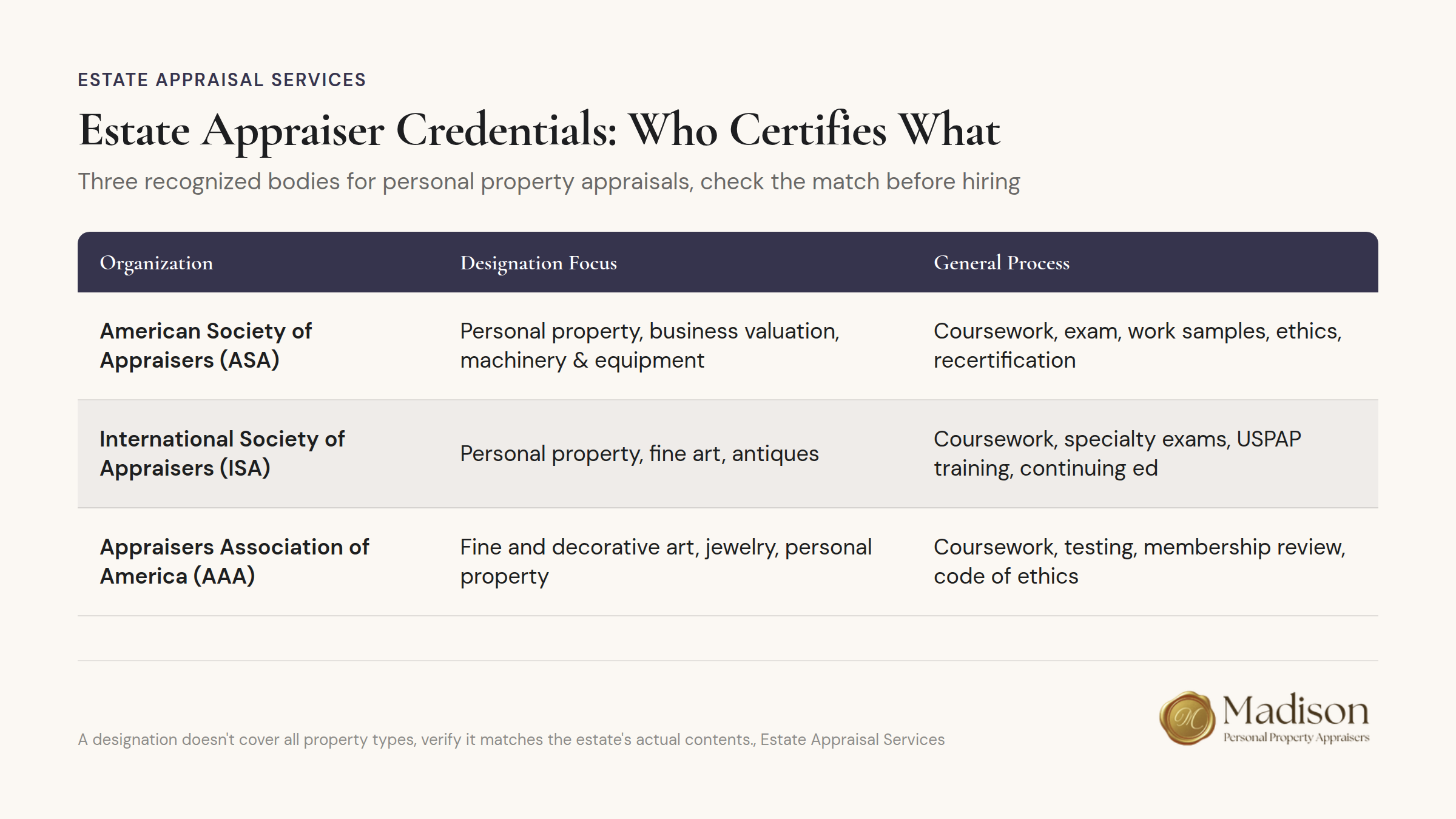
The American Society of Appraisers, the International Society of Appraisers, and the Appraisers Association of America are the three organizations most often referenced when an estate involves furniture, art, jewelry, collectibles, or general household contents. A designation from one of these groups signals that the appraiser has been tested on both appraisal theory and a specific area of expertise, not just familiarity with the objects themselves.
| Organization | Designation Focus | General Process |
|---|---|---|
| American Society of Appraisers | Personal property, business valuation, machinery and equipment | Coursework, exam, submission of work samples, ethics compliance, periodic recertification |
| International Society of Appraisers | Personal property, fine art, antiques | Core coursework, specialty exams, USPAP training, ongoing continuing education |
| Appraisers Association of America | Fine and decorative art, jewelry, personal property | Coursework and testing, membership review, adherence to code of ethics |
Holding one of these designations does not mean an appraiser is qualified to value everything. An appraiser certified in fine art is not automatically qualified to value farm equipment or a coin collection. Ask which specific property type the appraiser's designation covers, and whether it matches what's actually in the estate.
What Makes an Appraiser "Qualified" Under IRS Rules?
The IRS defines a qualified appraiser through Treasury Regulation 1.170A-17, and while that regulation was written for charitable contribution deductions, the same standard is the benchmark practitioners use for estate and gift tax valuations as well.
Under that regulation, a qualified appraiser generally must meet several conditions at once:
- Verifiable education and experience in valuing the specific type of property being appraised, not appraisal experience in general.
- A recognized appraiser designation for that property type, or completed coursework plus at least 2 years of relevant experience, with that background fully described in the report.
- Regular paid appraisal practice, meaning the appraiser prepares appraisals as an ongoing part of their work, not as an occasional favor.
- Independence, meaning the appraiser is not the executor, heir, a beneficiary, or anyone with a financial stake in the outcome.
The International Society of Appraisers has noted that meeting the education and experience bar for one category of property does not carry over to another. An appraiser qualified to value antique silver is not automatically qualified to value a classic car collection sitting in the same estate.
Key takeaway: A credential from ASA, ISA, or AAA supports IRS qualified appraiser status, but it doesn't guarantee it on its own. The appraiser still has to be qualified specifically for the property type in the estate, USPAP-compliant, and independent of the outcome. The IRS, not the appraiser or the appraisal company, ultimately decides whether a given report satisfies its requirements; a credentialed, USPAP-compliant appraisal simply gives that review the strongest possible foundation.
How to Verify an Appraiser's Credentials Before You Hire
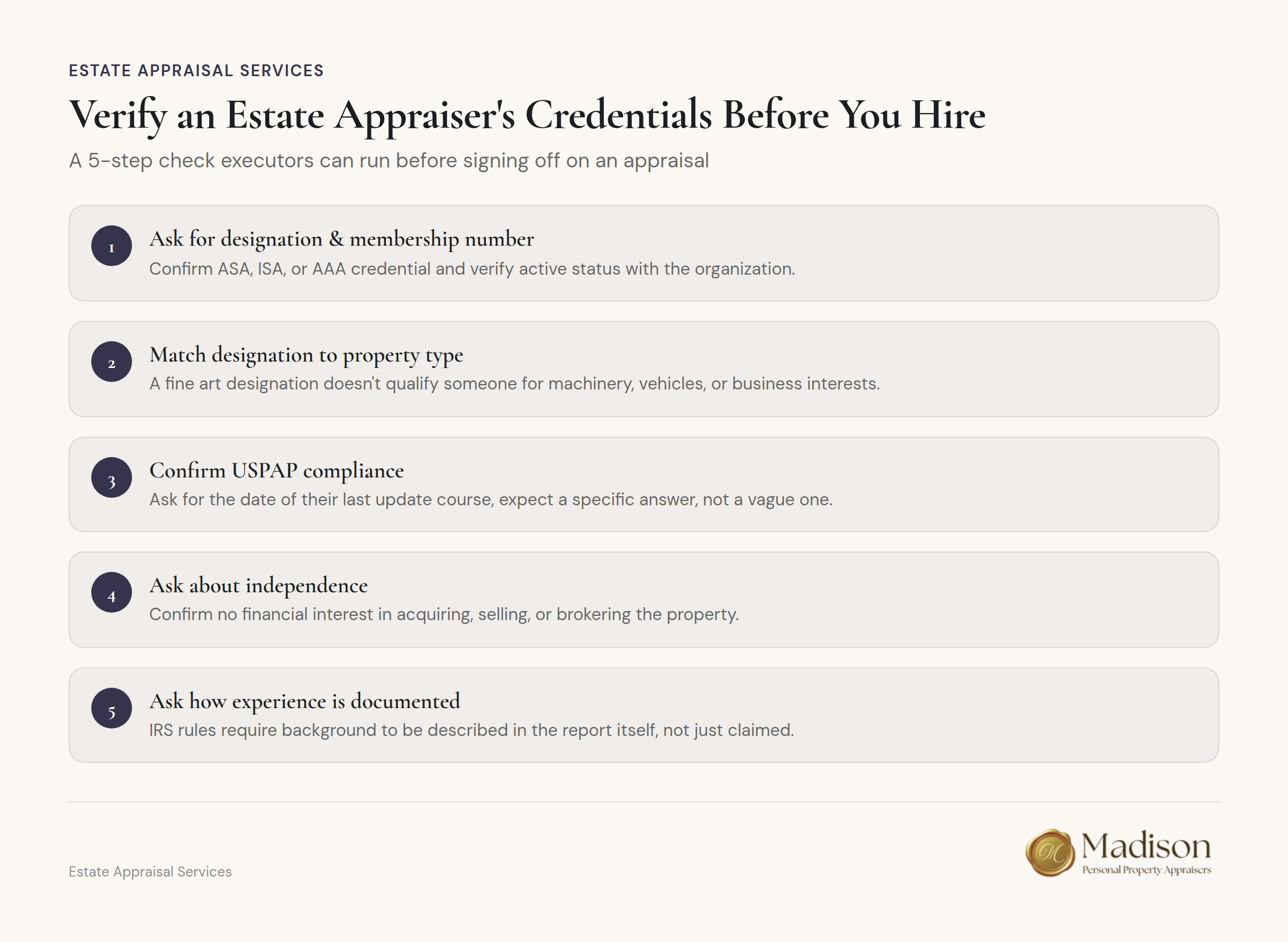
Executors under a probate deadline don't have time to research appraisal credentials from scratch. A short verification conversation before hiring saves much bigger problems later.
- Ask for the designation and membership number. A legitimate appraiser can tell you which organization (ASA, ISA, or AAA) they hold a designation with, and their membership or certification number. You can typically verify active status directly with the organization.
- Ask which property type their designation covers. A designation in fine art does not qualify someone to value machinery, vehicles, or a business interest. Match the appraiser's specialty to the actual contents of the estate.
- Confirm current USPAP compliance and the date of their last update course. This should be a quick, specific answer, not a vague assurance.
- Ask about independence. Confirm the appraiser has no financial interest in acquiring, selling, or brokering the property they're valuing.
- Ask how they document experience and continuing education. Under IRS rules, an appraiser's background needs to be described in the report itself, not just claimed informally.
When you're ready to move forward, our estate appraisal request process starts by matching the property in the estate to appraisers credentialed for that specific category, so the report is built to hold up from the start rather than patched together after a question comes up.
Getting the Credentials Right the First Time
Executors rarely get a second chance to value an estate at the date of death. If a probate court, the IRS, or an insurer later questions the valuation, going back and redoing the work under time pressure is far more expensive than getting the credentials right the first time. Confirming USPAP compliance, matching the appraiser's designation to the actual property being valued, and verifying independence up front are simple steps that protect the estate, the executor, and the beneficiaries who are relying on an accurate number.
This article is provided for general informational purposes only and does not constitute legal, tax, or financial advice. Readers should consult a qualified attorney or CPA regarding their specific circumstances.